





- Vendors market automated waste management software without defining capture method, accuracy threshold, or ingredient depth, so most shortlists compare marketing claims rather than potential ROI or cost savings.
- This guide delivers six evaluation criteria, definitions of "automated," an ROI framework, and a vendor checklist for your next demo.
- Platforms with ingredient-level tracking typically deliver up to 70% waste reduction and ROI within 4-8 months.
- Consistent capture methods across all sites make portfolio benchmarking reliable and highlight underperforming kitchens.
Accurate waste data also produces audit-ready CSRD reporting to help you stay compliant.
In a multi-site F&B operation, even small variances between expected and actual food costs can add up to significant losses over time. Most operators already know waste is happening. The challenge is identifying where it’s happening so you can take action.
Waste management software offers a solution, but vendor demos often focus on polished dashboards, making it difficult to judge how accurately a system captures waste in practice. If the underlying data is unreliable, the resulting decisions will be too.
This guide is designed as an evaluation framework. It helps F&B leaders assess whether a platform can produce reliable, actionable insights before investing time and budget in a pilot.
Why most waste tracking shortlists go wrong
Every food waste tracking software vendor in this category uses language like “automated”, “AI-powered”, “touchless” and “real-time”. In practice, these terms describe very different systems, from staff manually weighing and logging waste on a tablet to technology that records disposals without any input from kitchen teams. The result is a major difference in how you capture and measure waste, hidden behind almost identical messaging.
Shortlists based on brand recognition or polished dashboards often lead to pilots that stall and returns that never materialise. In multi-site restaurants or hospitality groups, these problems scale with the addition of more locations.
What "automated" actually means in waste tracking software (three levels)
Ask any vendor whether their waste management tracking system is automated, and the answer is usually yes. In practice, there are three distinct levels of automation in waste tracking systems, which differ in how data is recorded and how much staff input is required.
| Level | Capture method | Staff time per week | Accuracy range | Adoption after 90 days |
| Level 1 | Manual logging on a device where staff weigh waste and enter it during or after service | 1.5 to 3.5 hours | 60 to 75% | Low |
| Level 2 | Capture inside the bin, using scales or prompts where staff scan or record waste that is already mixed | 35 to 105 minutes | 70 to 85% (drops under high volume when items are mixed) | Medium |
| Level 3 | Above-bin automated capture, where items are recorded before they enter the bin with no staff input | None | ~90% ingredient-level | High |
Level 3 systems capture everything regardless of service pressure, which is the only way to achieve consistent data across shifts and sites. To identify which level a vendor is operating at, ask:
- At what point in the disposal process is waste recorded: before or after it enters the bin?
- Does the system require any change in staff behaviour or workflows during service?
- How does accuracy change when multiple items are discarded together?
The 6 features that help reduce food waste costs (and the 5 that don't)
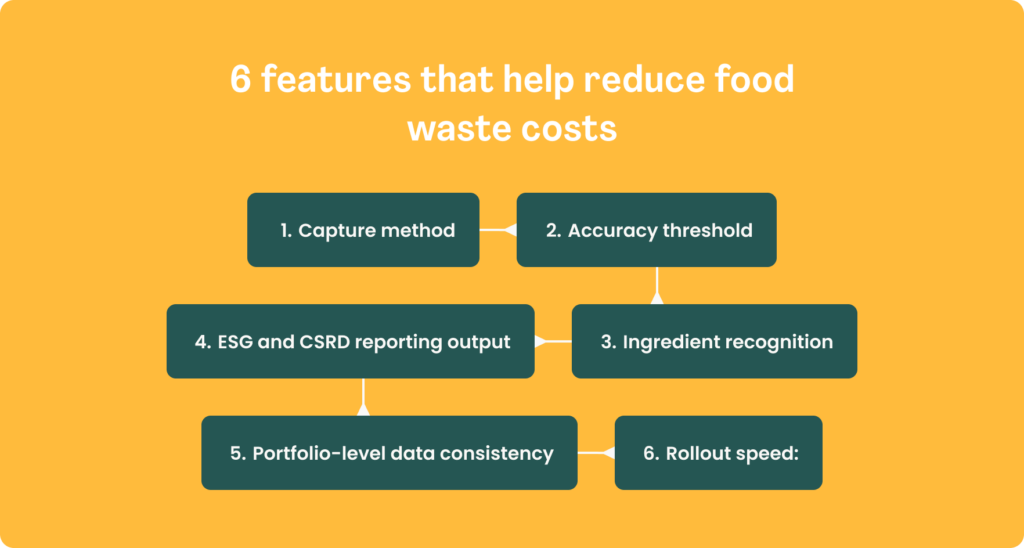
Six criteria determine whether a food waste tracking platform reduces food cost and produces reliable reporting:
- Capture method: How waste is recorded and whether it relies on user input.
- Accuracy threshold: How often disposals are correctly identified at the ingredient level.
- Ingredient recognition: How many items the system can distinguish and map to your menu.
- ESG and CSRD reporting output: Whether you can export data in an audit-ready format.
- Portfolio-level data consistency: Whether the same structure and method work across all sites and facilities.
- Rollout speed: How quickly the system produces usable data across a full portfolio.
Five commonly promoted features that don't affect these outcomes include gamified leaderboards, custom dashboard themes, mobile apps for floor staff, AI chatbots, and sustainability badges.
If a feature doesn’t change food cost on the P&L or improve data quality for audit reporting, don’t use it to shortlist a vendor. Here’s a closer look at each of the six criteria.
1. Capture method: Above-bin vs inside-the-bin vs barcode
Where and when a system captures waste determines what it can tell you.
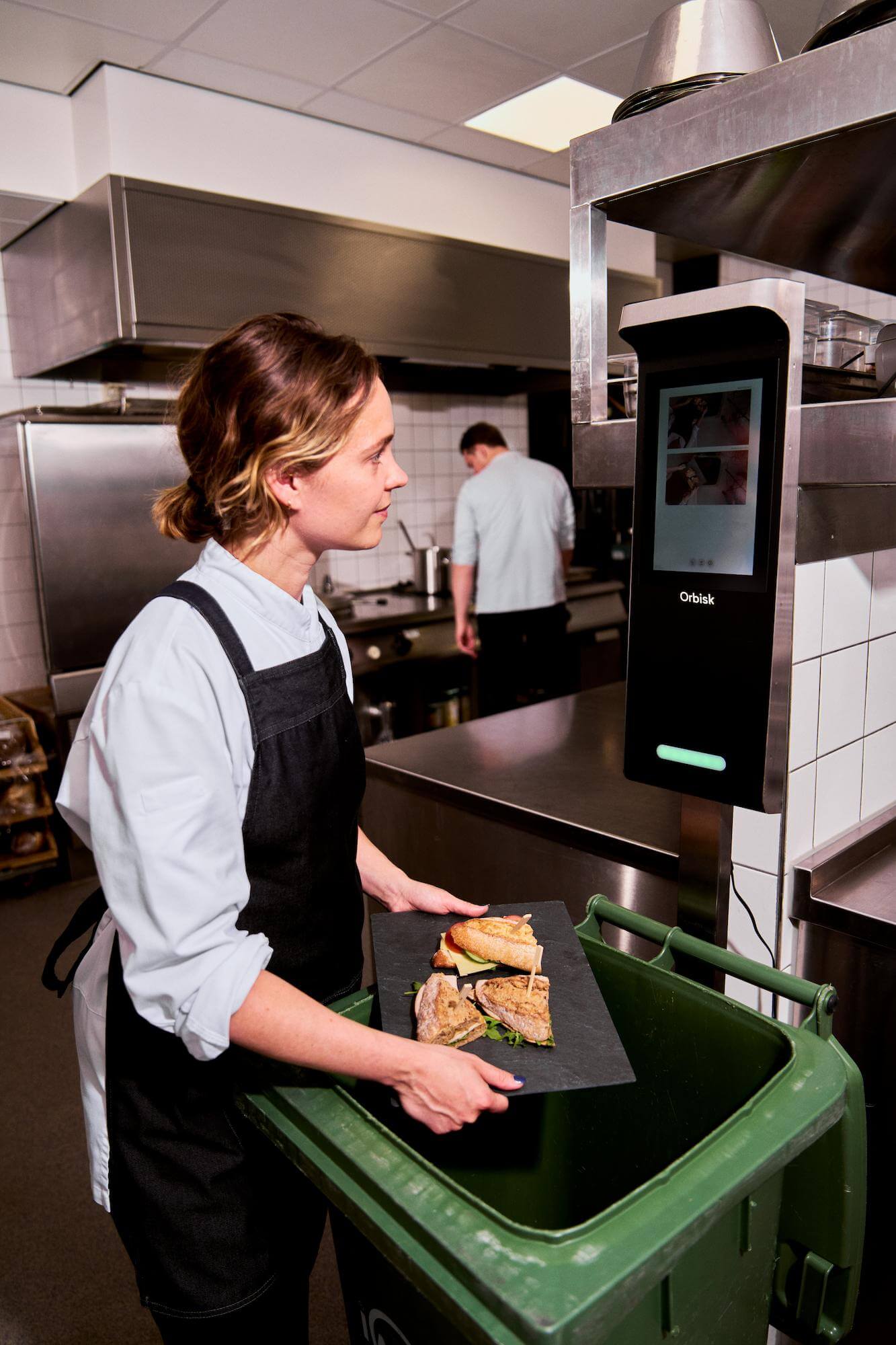
- Above-bin capture identifies each item as it is thrown away, before anything enters the bin. It records container type, waste stream (e.g. prep, overproduction or plate waste), and individual ingredients separately, such as 1kg salmon prep waste and 400g lettuce overproduction. This level of detail makes it possible to trace cost issues back to specific ingredients and points in service.
- Inside-the-bin capture records waste after it has been mixed together. At that point, the system cannot reliably identify individual ingredients, especially when multiple items are discarded at once.
- Barcode or scale-with-prompt systems rely on staff to interact with the tracking tools during service. That makes accuracy inconsistent under pressure and harder to maintain across multiple sites.
Confirming the capture method should be the first step of your discussion with vendors. It directly affects data quality and staff adoption and sets a hard limit on how precise the system can ever be, regardless of features layered on top.
2. Accuracy thresholds: How close is close enough for cost control?
~90% ingredient-level accuracy is the threshold at which waste data becomes usable for cost control. It lets you see which ingredients are driving losses and which kitchens are responsible, so you can adjust purchasing and menu decisions based on solid numbers.
At 60 to 70% accuracy, the data shows waste activity but loses detail at the ingredient level. The system might log 800g of salmon as generic white fish or miss disposals entirely during a busy service. The cost figures that follow from that data are unreliable, which means decisions based on them are too.
Photo evidence strengthens the record. You can’t check and verify a manually selected category and weight, but you can with a timestamped image linked to an ingredient entry.
3. Ingredient recognition breadth: 800+ items vs 30 categories to track waste
Category-level tracking doesn’t give enough detail to fix waste problems. It shows where waste happens in broad terms, but not what’s actually driving the cost. Compare two outputs from the same disposal:
- Category-level capture might record "1.5kg fish dish."
- Ingredient-level capture would be "1kg salmon prep waste, 400g lettuce overproduction, 100g lemon, lunch service."
When the data shows 1.5kg of fish dish, the only available response is a general suggestion to waste less fish. When it shows 1kg of salmon trim from prep, the problem is a prep yield issue with a specific ingredient and a specific fix.
4. Multi-site rollout: Same-day setup vs months of training
How the system is installed directly impacts rollout speed and how quickly you can use waste data to reduce costs. Here are the differences between the two approaches:
| Systems that can be deployed in a single day | Systems that require installed hardware and training | |
| Setup time per site | Each site can be set up in under one hour with no installation required. | Each site requires hardware installation that can take several days or weeks. |
| Training required | Staff do not need training before the system can be used. | Staff training is required, often taking around 100 hours per site. |
| IT involvement | No IT setup or configuration is required. | IT teams are often needed for network setup and system configuration. |
| Time to usable data | Data becomes available within days. | Usable data may take weeks or months to appear after rollout. |
| Risk at scale | Rollout is consistent because every site follows the same process. | Rollout complexity increases because each site requires a separate setup. |
If rollout methods differ across sites, benchmarking becomes unreliable. A portfolio only produces comparable data when every location captures waste in the same way.
5. ESG and CSRD reporting: Audit-ready outputs vs generic dashboards for your sustainability goals
Waste tracking systems often claim alignment with CSRD, GRI, CDP, or SBTi reporting frameworks. In practice, reporting quality depends on the structure of the exported data.
In a demo, request the raw export file and review its format. Audit-ready output contains structured records you can use directly in environment and sustainability reporting workflows, for example, per-site, per-ingredient, and per-week entries with timestamps and linked photo evidence.
Some systems provide data through graphs or dashboards designed for visual reporting, generating exports as PDFs or aggregated summaries. You typically need to reformat them to meet formal audit submission guidelines, creating more manual work.
6. ROI calculation framework: Savings per kitchen and payback period
The starting point for any business case is: (annual savings per kitchen × number of sites) − annual platform cost = net annual return.
Express savings as a percentage reduction in food cost rather than a fixed per-site figure, then apply that across the portfolio. Based on Orbisk data, kitchens typically see a 2% to 5% food cost reduction in the first year, depending on baseline waste levels and how actively kitchen teams engage with the data. Use your own food cost data to translate this into a site-specific estimate.
The platform pays for itself when cumulative savings across the portfolio exceed the annual platform cost. Orbisk customers typically reach that point within 4 to 8 months.
In the first 4 to 8 weeks, use the data to check that the system captures waste correctly and consistently, but not to project annual savings or calculate payback. Wait until patterns stabilise and the data reflect normal operations before making those calculations.
Waste management software evaluation checklist (use this in your next demo)
Use this checklist to see if potential food waste tracking systems meet the six criteria.
| Criterion | Benchmark | Y/N |
| Capture method | The system records waste above the bin without requiring staff to pause or log entries during service. | |
| Accuracy | The vendor commits in writing to around 90% ingredient-level accuracy as a measurable target. | |
| Ingredient breadth | The system recognises around 800 individual ingredients rather than grouping waste into broad categories. | |
| ESG reporting | The system produces CSRD-aligned exports with evidence materials like timestamped photos to use in audits without reformatting. | |
| Integrations | The system includes live POS and procurement integrations that give revenue and ingredient-level cost data. | |
| Rollout | Each site can be installed in a single day without wall mounting or IT involvement |
What the benchmark looks like in practice: How Orbisk scores against all 6 criteria
When waste data is captured at the ingredient level and shared consistently across a portfolio, hotels and contract caterers stop relying on monthly stocktakes to understand cost. You can monitor which ingredients and which sites are driving waste in near real time, down to shift level.
Here’s how Orbisk performs against each criterion, making it possible to reduce food waste before costs build up:
- Capture method: Every disposal is recorded above the bin, before ingredients mix, without staff needing to pause or interact with the system during service.
- Accuracy: The built-in AI identifies ingredients with around 90% accuracy, giving reliable numbers for cost attribution and purchasing decisions.
- Ingredient breadth: Over 800 individual ingredients are identified by name, weight, waste stream, container type, station, and shift, giving enough detail to act on specific problems.
- ESG output: Reports aligned to CSRD, GRI 306, and IFRS S2 are generated automatically, complete with timestamped photo evidence.
- Integrations: Native connections to Silverware POS, Mews, and Opera Cloud mean waste data flows into existing systems without manual exports.
- Rollout: Each site is self-install in under one hour, with no IT involvement or training required.
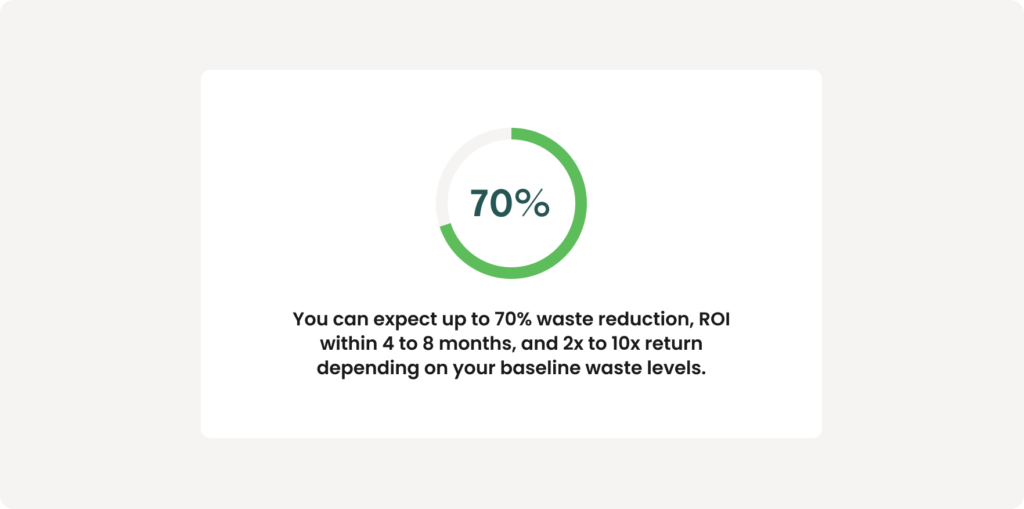
Our data shows you can expect outcomes of up to 70% waste reduction, ROI within 4 to 8 months, and 2x to 10x return depending on your baseline waste levels.