







- Auditors expect traceable, site-level food waste data with a documented method. Measured figures are far easier to defend than estimates.
- CSRD, the revised EU Waste Framework Directive and national food waste laws are turning food waste into a reported, assured number. SASB and GRI shape how it is disclosed.
- Manual logging fails under service pressure. Figures get back-filled, and back-filled data is hard to trace when an assurance provider asks how it was compiled.
- Capture at the moment of disposal produces ingredient-level, audit-ready records at every site, automatically.
Your ESG lead submits the quarterly waste report. Auditors open it. Half the figures are estimates, reconstructed from manual logs nobody finished during a busy service week.
That's not a reporting problem. That's an audit risk, a board conversation you can't win, and a sustainability target you can't defend.
Guesswork has a cost. It shows up in numbers that shift when someone asks a follow-up question. In decisions deferred because the data doesn't hold. In ESG disclosures that expose gaps instead of closing them.
This article sets out what regulators and auditors expect from food waste reporting, the national laws already in force, a readiness checklist, and a five-step policy framework for multi-site groups.
Facts replace guesswork.
Why food waste reporting is now a compliance issue
Food waste is moving from a voluntary line in your sustainability report to a number that regulators track and assurance providers test. Two EU shifts are driving that, with national laws following behind.
First, CSRD put sustainability reporting, including resource use and the circular economy, under limited assurance for companies in scope (Directive (EU) 2022/2464). Second, the revised EU Waste Framework Directive entered into force on 16 October 2025 (European Commission).
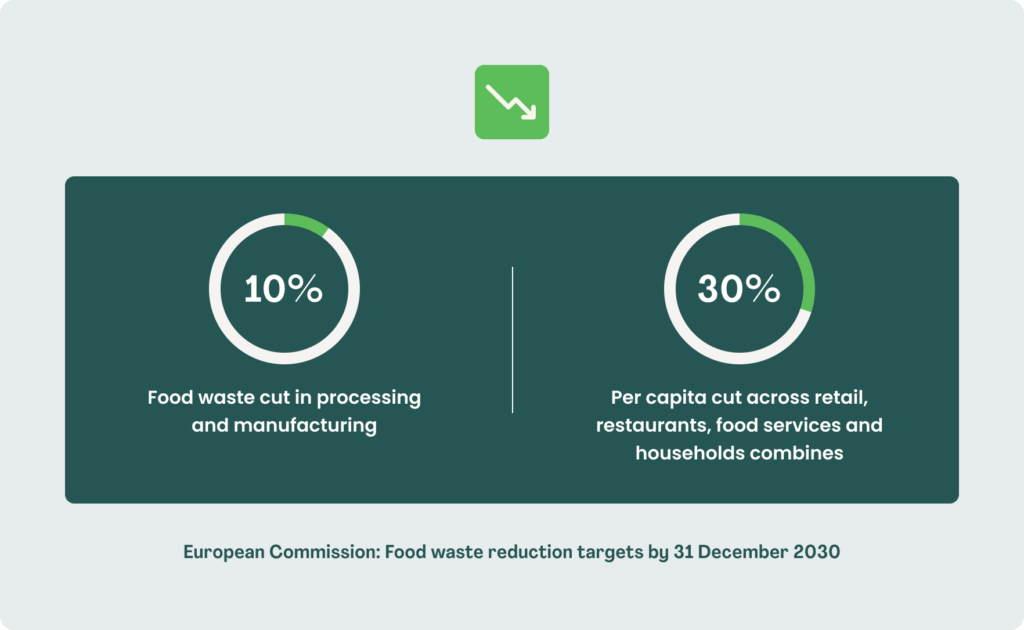
It sets the first binding EU food waste reduction targets. Member States must cut food waste by 10% in processing and manufacturing, and by 30% per capita across retail, restaurants, food services and households combined, by 31 December 2030 against a 2021–2023 baseline (European Commission: food waste reduction targets). They must transpose the directive into national laws by 17 June 2027 (European Parliament Legislative Observatory).
The targets sit with Member States, not directly with your business. But the national rules written to meet them will decide what operators have to do, and the directive explicitly expects restaurants, hotels and catering to play an active part in waste prevention.
The data trail is already there at national level. Since the 2020 reference year, every Member State has had to report food waste across the whole food supply chain to the European Commission each year, using a common methodology. Eurostat's latest figures put EU food waste at 57.9 million tonnes in 2024, about 129 kg per person. Households generated 53%, and restaurant and catering services 12% (Eunews, reporting Eurostat data).
All of this feeds a global commitment. Sustainable Development Goal 12.3 aims to halve food waste at retail and consumer level, and reduce food loss along production and supply chains, by 2030. Food loss and waste together generate an estimated 8–10% of global greenhouse gas emissions (UN News, on the UNEP Food Waste Index Report 2024), which is why climate change targets keep pulling food waste into public policy.
For multi-property groups, buffet, banqueting and à la carte outlets need to produce one set of numbers that holds up to scrutiny. Without a shared capture method, you're aggregating apples and estimates.
Visual (2): Timeline graphic: voluntary ESG disclosure → CSRD reporting with limited assurance → revised Waste Framework Directive in force (16 October 2025) → transposition into national laws (17 June 2027) → binding 30% per capita target by 31 December 2030.
CSRD
CSRD requires companies in scope to report on resource use and the circular economy where the topic is material, under the European Sustainability Reporting Standards (ESRS E5), with that reporting subject to limited assurance (Directive (EU) 2022/2464). For a hospitality group, food is often the largest waste stream, so it is likely to surface in your double materiality assessment. A documented methodology makes the assurance review easier.
The 2026 Omnibus, Directive (EU) 2026/470, narrowed CSRD scope to EU companies with more than 1,000 employees and over €450 million net turnover, so check whether your group is still in. The ESRS themselves have since been simplified, with fewer datapoints, so confirm which version applies to your financial year. Our ESG regulations guide for the food sector sets out the wider picture.
SASB
SASB code FB-RN-150a.1 asks restaurants for total waste, the percentage that is food waste, and the percentage diverted (ReFED Food Waste Measurement and Reporting report). SASB is voluntary and now maintained by the ISSB, but many investors still use it as a benchmark. For multi-site groups, an accurate group-level diversion percentage depends on data traceable to each site.
GRI
GRI 306-3 requires total waste weight in metric tons, broken down by composition. It also requires contextual information on how the data was compiled (GRI 306: Waste 2020). Its guidance lets you state whether figures are modelled or directly measured. For a multi-site group, ad hoc logs make comparability hard to demonstrate.
National food waste laws hospitality groups already face
You don't have to wait for 2027 to see where national laws are heading. Several countries already have rules that touch hospitality, and they share a pattern: prevent waste first, donate surplus food, and keep records that prove it.
Spain

Law 1/2025 on the prevention of food loss and waste requires businesses across the food chain to adopt prevention plans, prioritise donation to food banks and non-profit organisations, and let restaurant customers take leftovers home at no extra cost. Fines run from €2,000 up to €500,000.
France

Since the 2016 Garot law, supermarkets over 400 m² cannot destroy edible food and must have donation agreements in place. Later legislation set collective catering a 50% food waste reduction target against 2015 levels, required waste diagnostics and tracking, and requires restaurants to offer takeaway containers for leftovers (FCSI).
UK

Food waste reporting is still voluntary. Businesses that sign up to WRAP's Food Waste Reduction Roadmap and the Courtauld Commitment 2030 measure and publish food waste data against a target to halve food waste by 2030. The UK government consulted on mandatory food waste reporting for large food businesses in England and initially chose not to proceed. In November 2025, ministers said a circular economy taskforce was still considering it (Foodservice Footprint). Separately, businesses in England with 10 or more employees have had to separate food waste for collection since 31 March 2025 (House of Commons Library).
United States

There is no federal mandatory reporting, but the US has a national goal to halve food loss and waste by 2030. In California, SB 1383 has required hotels with an onsite food facility and at least 200 rooms, and restaurants with at least 250 seats or 5,000 sq ft, to recover the maximum edible food they can since January 2024. They need written agreements with food recovery organisations and monthly records of what they donate.
If you operate across borders, each of these regimes asks for slightly different evidence. A single measured dataset at every site is the only practical way to answer all of them without running separate logging systems.
Prevention, donation, disposal: where the waste hierarchy fits
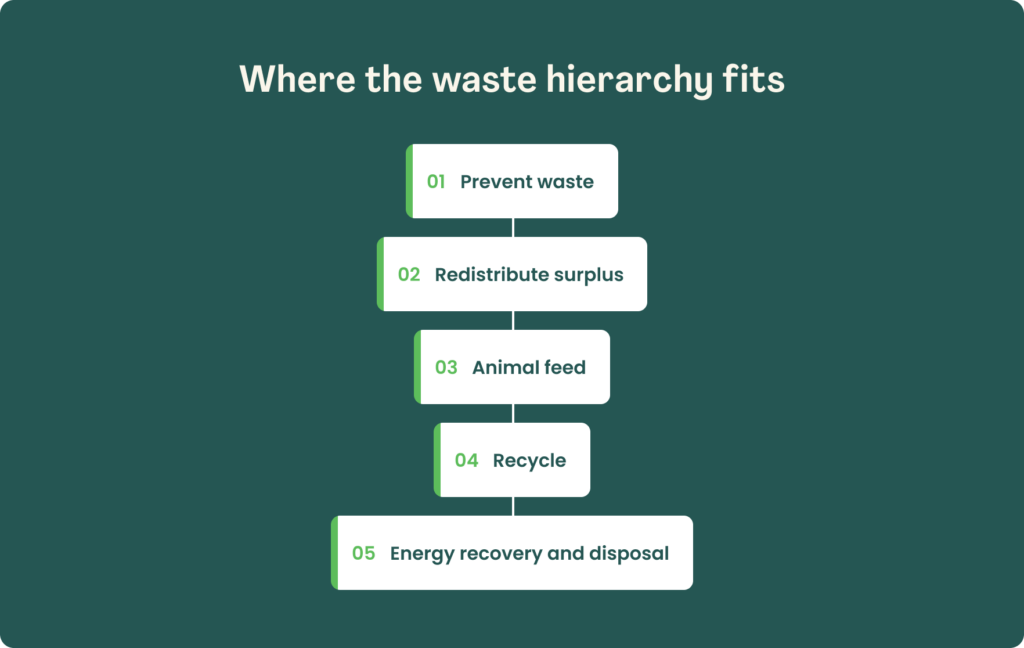
Every one of these frameworks follows the waste hierarchy. It ranks options by resource efficiency and environmental impact:
- Prevent waste. Don't buy, prep or cook food that won't be eaten.
- Redistribute surplus. Donate perfectly good, edible food to food banks and charities.
- Animal feed. Largely a route for food manufacturers and farmers. In the UK and EU, catering waste cannot legally be fed to farmed animals.
- Recycle. Anaerobic digestion turns food waste into biogas for energy, and composting returns nutrients to the soil.
- Energy recovery and disposal. Incineration with energy recovery, then landfill as the last resort.
This matters for your reporting. A diversion rate, the metric SASB asks for, tells you how much waste avoided landfill. It doesn't tell you how much food you wasted in the first place. A group can send 100% of its food waste to anaerobic digestion and still bin tonnes of food it paid for.
Regulators are increasingly focused on the top of the hierarchy. The EU targets measure waste generated, not waste diverted. To show progress against them, you need to measure what is thrown away, by ingredient, before it leaves the kitchen.
What auditors will ask about your food waste data
Expect four questions. Here is what a strong answer looks like:
- How was it measured? Automatically, at the moment of disposal, for every discard.
- By whom? By a system, not by staff remembering to log mid-service.
- How often? Every disposal, every service, every day.
- Can you trace it by site? Yes, by location, ingredient, meal period and date.
These four questions are the standard Orbisk's data is built to answer.
Food waste reporting readiness checklist
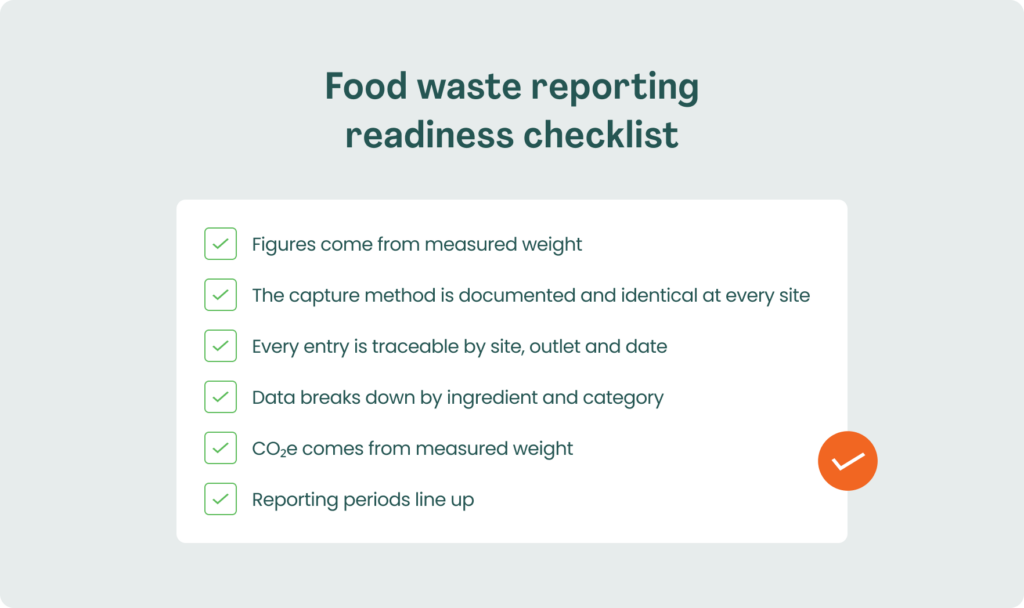
Run through this before your next sustainability report. Six questions. Honest answers only.
- Figures come from measured weight. Every discard is weighed, not reconstructed from portion guides or staff memory.
- The capture method is documented and identical at every site. Without one standard, multi-site data isn't comparable. It's noise.
- Every entry is traceable by site, outlet and date. Any figure can be traced to a kitchen, service and timestamp.
- Data breaks down by ingredient and category. A single monthly total tells you nothing you can change.
- CO₂e comes from measured weight. It is reported as kg CO₂e total, per guest, and % vs baseline.
- Reporting periods line up. Site data covers the same financial year as your group disclosure, with no gaps to fill by estimate.
The usual weak point: logs back-filled at month-end that can't answer one question about methodology.
Why manual logging fails the audit test
Manual logging doesn't fail because your staff are careless. It fails because it asks too much at the wrong moment: mid-service, hands full, tickets on the pass.
- No consistent ground truth across sites. Every kitchen logs differently. You cannot standardise what you cannot compare.
- Reports arrive late. Prep quantities, purchase orders and production schedules are already set. The data lands after the decision.
- Category-level only. "Food waste: 12kg." No ingredient. No meal period. No root cause.
For your CFO, incomplete data means food cost ratios cannot be explained or benchmarked across sites. You cannot defend a number you cannot trace. Most kitchens have been flying blind for years, and Orbisk's food waste intelligence platform was built to close that gap.
Not a data problem. A capture problem.
How Orbisk captures food waste data at the source
Reporting is only as good as capture. If reporting depends on staff remembering to log, you already have a gap.
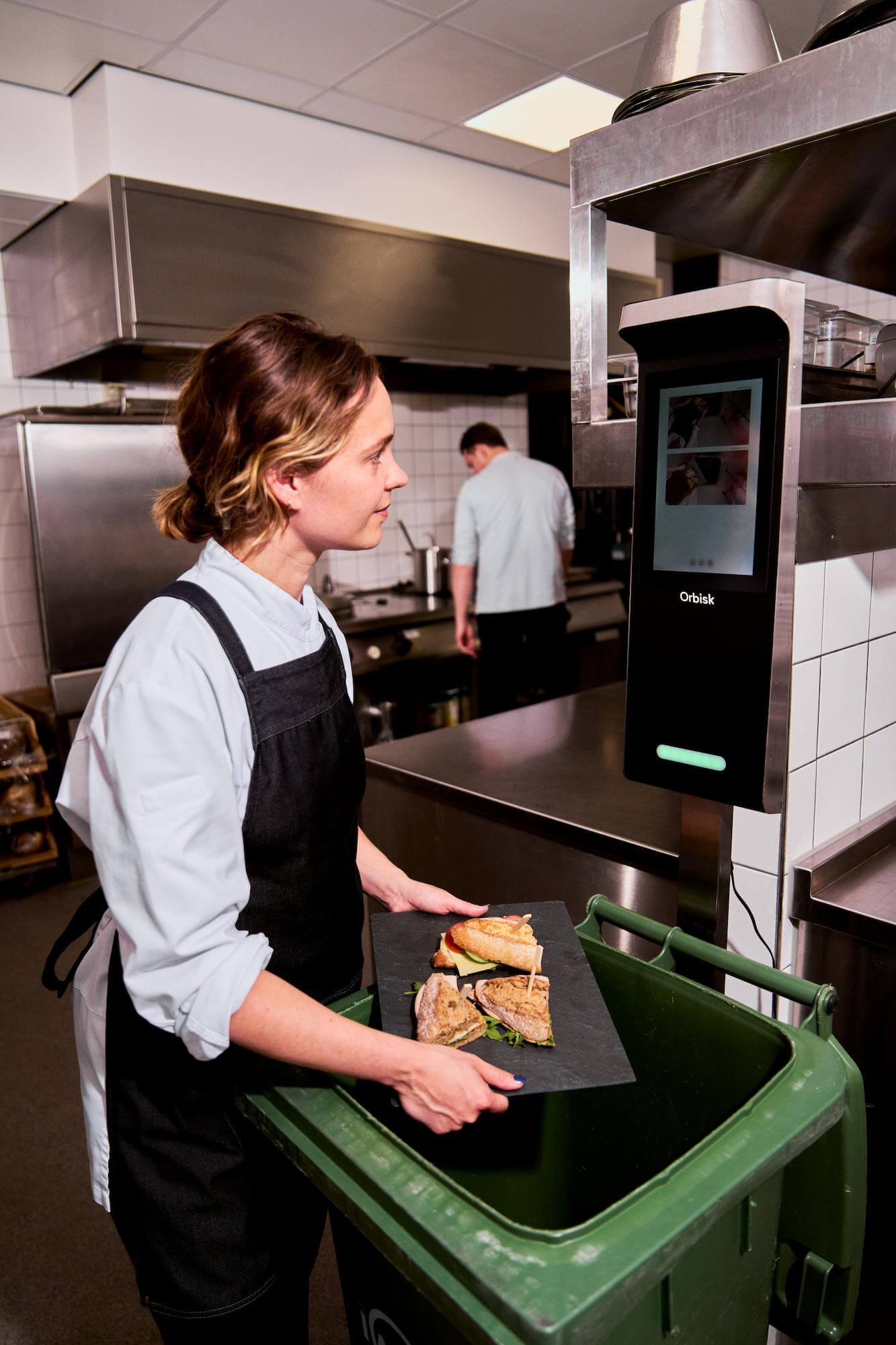
Orbisk, the food waste intelligence platform for commercial kitchens, closes it at the moment of disposal. Every discard is photographed and its weight recorded as it is thrown away, before anything mixes. See how Orbisk's above-the-bin capture works.
No buttons. No logging. No training required. It works like an extra pair of eyes in your kitchen.
Staff throw. Orbisk captures everything.
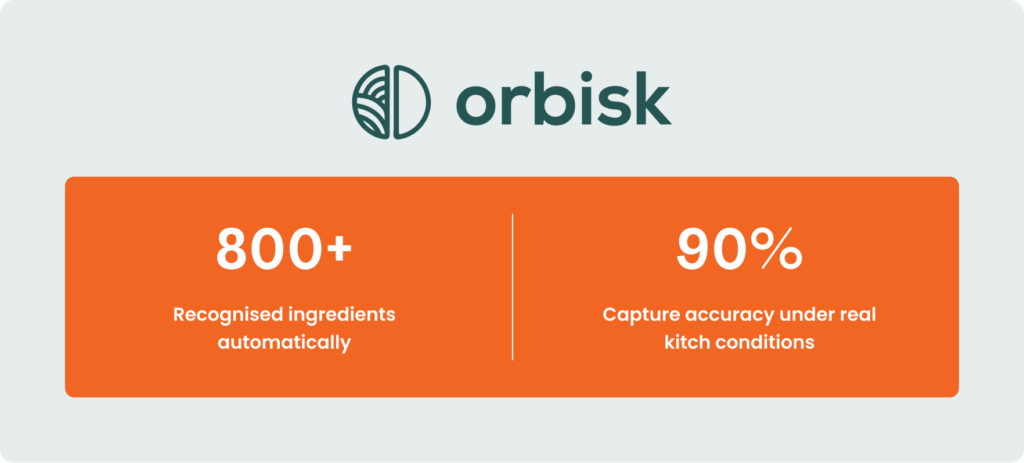
Two numbers that matter for your food waste reporting:
- Recognises 800+ ingredients automatically.
- Captures with ~90% accuracy under real kitchen conditions.
That accuracy makes ingredient-level food waste tracking useful rather than decorative. You see waste by ingredient, station and waste stream: overproduction, prep waste and plate waste. Each one is reportable, and each one points to a purchasing or prep decision you can change. Every site runs the same full system, so data stays comparable across the group.
A five-step food waste policy framework for multi-site groups
A food waste policy is only as strong as the data every site produces. Build yours on five steps.
- Standardise capture at every site. Use one measurement method across buffet, banqueting and contract catering. With Orbisk, every site runs the same set-up.
- Set a measured baseline per site. Record actual waste volumes before any intervention, then set each site's food waste target from that starting point. Orbisk's six-week baseline gives each site its starting point.
- Define one category structure. Report by ingredient, waste stream and serving stage everywhere, and record where surplus goes: donation, anaerobic digestion or general waste. Shared categories make portfolio comparison possible.
- Assign site-level owners and one reporting cadence. Each site owns its numbers, reviewed on the same schedule, so you are tracking progress against the same target everywhere. Accountability without consistency produces noise.
- Document the method for auditors. Record who captures data, how often, and how CO₂e is calculated. Orbisk's automatic, timestamped records give that file its evidence.
Treat the policy as part of your risk management, not only your sustainability programme. It is what lets you respond when national rules change, without rebuilding your data.
How Orbisk makes food waste reporting audit-ready
The ESG lead who spent last quarter defending half-estimated figures knows what's at stake in a CSRD disclosure. Estimates get queried. Measured numbers hold. That is the gap between measured and estimated waste data.
Measured. Every disposal is captured at the moment it is thrown away, with ~90% accuracy across 800+ ingredients. The actual number, not an estimate.
Multi-site. Every location runs the same Orbisk set-up from day one, so every site behind your headline figure has the same evidence trail and the group reports one consistent dataset.
Ingredient-level. You see cost per ingredient and per category, plus the CO₂e of your food waste: kg CO₂e total, per guest, and % vs baseline. That is the structured, audit-ready food waste data third-party assurance looks for.
Orbisk exports this as data structured for CSRD-ready disclosure, and supports GRI 306 disclosures on waste prevention and management.
Activation is straightforward. A six-week baseline comes first. Your top wasted ingredients then surface automatically, and operators approve action suggestions in one click.
The business case stands on its own. Kitchens report an average of 40–50% food waste reduction. ROI arrives within 4–8 months, depending on food volume and existing waste levels, at 2x–10x. For your CFO, food cost ratios become explainable, with cost savings measured in months. For your ESG lead, the numbers going to auditors are measured, not estimated. TRIBE London Canary Wharf cut its food waste by 37% with Orbisk.
Ready to run your kitchen on facts?
Book a demo to see measured data from kitchens like yours.