






- Clipboard logs fail under service pressure. Tracking reverts to guesswork within days, so prep and ordering stay on intuition.
- Each waste stage needs its own fix. Prep loss, overproduction, plate waste and expired stock have different causes. One "mixed waste" bucket solves none of them.
- The cadence runs on measured data. A daily shift check, a weekly station review and a monthly outlet reset, each based on what was actually discarded.
- Orbisk captures every disposal as it is thrown, before items mix, with no staff input. It identifies 800+ ingredients at ~90% accuracy, with ROI typically within 4–8 months, depending on food volume and existing waste levels.
Knowing how to manage food waste in restaurants starts with a measurement problem. Tomorrow's prep, this week's order and next month's menu are built on estimates. Not facts.
The method failed, not the team. Clipboards break under service pressure, and "mixed waste" tells you nothing you can change.
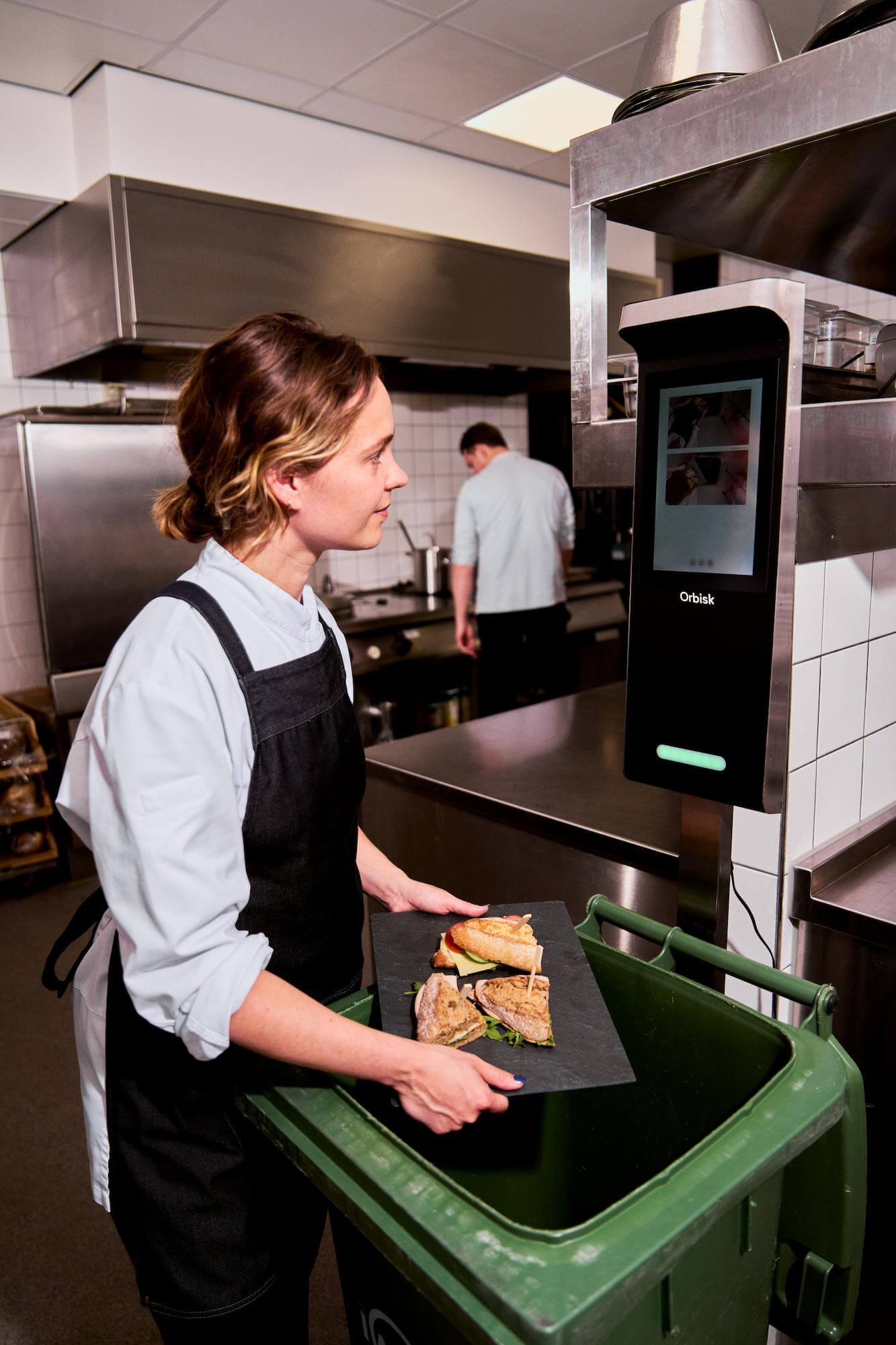
Orbisk, the food waste intelligence platform, measures waste by ingredient without anyone stopping at the bin. You can start the cadence below this week. Staff throw. Orbisk captures everything.
Why manual waste logs fail inside a week
The sheet goes up on Monday. Service pressure hits by Tuesday. By Friday, it is blank, because logging competes with service and service always wins. Training staff won't fix it, and what gets logged carries human error.
The second failure is timing. A weekly summary reviewed on Thursday cannot change Wednesday's prep or Tuesday's order. A one-off food waste audit gives you a snapshot, not waste tracking data for each shift.
The third failure hits multi-outlet groups hardest. One outlet logs by weight, another by category. You get versions of the truth that cannot be benchmarked.
Estimated waste vs measured waste
| Estimated (manual log) | Measured (Orbisk capture at disposal) | |
| Accuracy | Partial, staff-dependent | ~90% accuracy across 800+ ingredients |
| Timing | Retrospective, often days late | Captured at the point of disposal |
| Consistency | Varies by outlet and shift | Identical method at every location |
The four stages of restaurant food waste
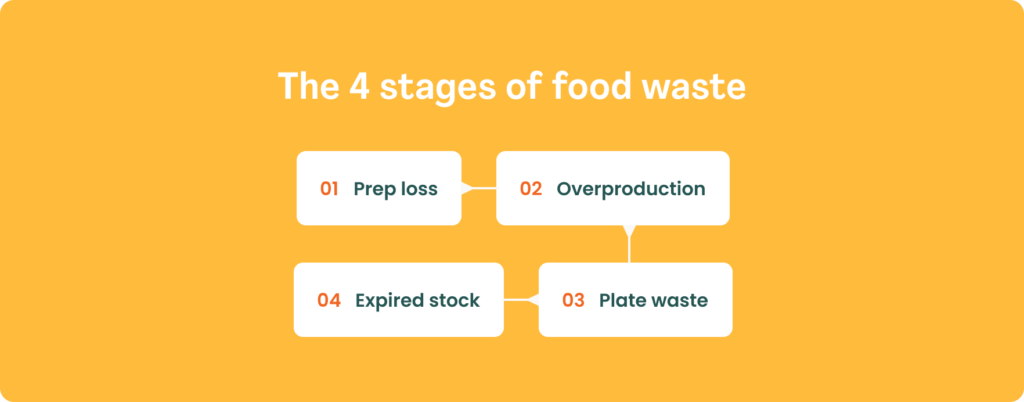
Start with where waste happens.
Prep loss
Prep loss is preparation waste: food trimmed or discarded before service. Vegetable peels are unavoidable; edible food in the trim bin is not. The fix: right-size prep by ingredient and use offcuts in new dishes or batch cooking.
What Orbisk shows: trim volume by ingredient at the prep stage, so you see which items generate the most offcuts.
Overproduction
Overproduction is food binned because too much was prepared: full trays scraped at close, proteins over-prepped every Friday. The fix: demand forecasting by meal period and day, so you cook only what you will sell. Unavoidable surplus food can go to food banks or local charities, but prevention saves more.
What Orbisk shows: overproduction by meal period and day, against covers.
Plate waste
Plate waste is customer leftovers: what comes back uneaten. When the same dishes return half-full, portion sizes or menu balance are off. The fix: rework unpopular dishes and consider flexible portion sizes.
What Orbisk shows: which dishes and ingredients come back from the floor.
Expired stock
Expired stock is food you bought and never used: untouched produce, dairy past date, protein for a slow-selling dish. High-risk foods with a short shelf life are the usual culprits. The fix: tighter orders, better storage solutions and smaller, more frequent deliveries from local suppliers.
What Orbisk shows: which ingredients keep reaching the bin, by weight, to check against what you ordered.
A three-loop review cadence
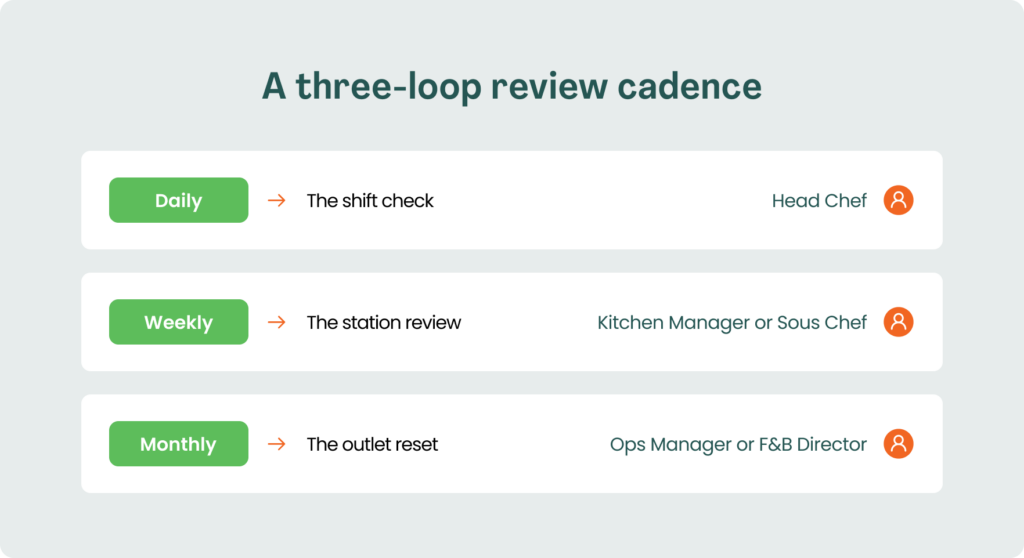
Each loop has one owner, one question and one decision.
Daily: the shift check (head chef)
- Question: Where did waste spike this shift, and which station drove it?
- Data: Weight, ingredient and time of every discard, by shift and station.
- Decision: Cut tomorrow's prep at the stations that overproduced today. Not the whole kitchen.
- Time: Five minutes per shift.
- Cost of skipping: The same stations overproduce again tomorrow.
Weekly: the station review (kitchen manager or sous chef)
- Question: Are par levels and order quantities still right?
- Data: After a six-week baseline, Orbisk surfaces your top wasted ingredients automatically, with weight and cost attached.
- Decision: Approve or reject Orbisk's weekly action suggestions in one click, with no manual ranking.
- Time: 20 minutes.
- Cost of skipping: Par levels drift and over-ordering becomes the default.
Monthly: the outlet reset (ops manager or F&B director)
- Question: Is one location quietly pushing up group food cost?
- Data: Every outlet side by side, by ingredient and category, tied to food cost.
- Decision: Update menus, purchasing and production plans.
- Time: 60 minutes.
- Cost of skipping: Food cost rises with no explanation.
How to manage food waste in restaurants: methods compared
| Method | How it captures | Staff effort | Service disruption | Data completeness | Time to decision | Multi-outlet consistency |
| Clipboard log | Staff write by hand | High: every discard | Interrupts service | Partial, with gaps under pressure | Days to weeks | Low: format varies by site |
| Spreadsheet | Manual entry after service | Medium: batch entry | Delayed, not real time | Estimated totals only | Days to weeks | Low: depends on staff discipline |
| In-bin capture | Inside the bin, as items land | Low | Minimal at point of discard | Depends on each item registering as it lands | Varies by system | Varies by system |
| Orbisk above-bin capture | Each item captured as it is thrown, before it mixes | None at the bin | None | 800+ ingredients at ~90% accuracy, by meal period and location | By shift | High: identical capture at every outlet |
Inventory management software works from purchasing data: what should have been used, not what was binned. Partial data cannot support a cadence.
When every outlet runs the same capture method, the group gets one ground truth. You can compare Monday breakfast waste in Edinburgh against Manchester, ingredient for ingredient.
How Orbisk makes the cadence hold
It works like an extra pair of eyes in your kitchen. Capture happens at the moment of disposal, before items mix, at every outlet.
Orbisk's AI imaging system records every disposal automatically. Staff throw. Orbisk captures everything. No taps, no logging, no training. It recognises 800+ ingredients at ~90% accuracy, recording weight, ingredient, meal period and location.
Your team does nothing extra at the bin or at shift end.
Every food cost variance maps to a waste pattern you can name, such as 4.2 kg of salmon discarded at Tuesday prep (an illustrative figure). For ESG reporting, Orbisk produces CSRD-ready, audit-ready figures on the greenhouse gas impact of your own operations: kg CO₂e (carbon dioxide equivalent) in total and per guest, with percentage saved against your six-week baseline.
Kitchens using Orbisk see up to 70% food waste reduction, with ROI typically within 4–8 months, depending on food volume and existing waste levels.
Ready to run your kitchen on facts?
See real data from kitchens like yours.
FAQ
Daily: the kitchen adjusts prep for the next service.
Weekly: the chef reviews ingredient trends and updates prep briefs.
Monthly: operations leadership compares locations and resets benchmarks.