







- Commercial kitchens waste 5–15% of food purchased. On thin contract margins, that gap is where profit disappears.
- Estimated, site-by-site waste data cannot explain a food cost spike to finance or your client. Measured numbers can.
- Large operators are moving to standardised, ingredient-level data captured automatically at every site, replacing inconsistent manual logs.
- Orbisk kitchens report up to 70% waste reduction (with an average of 40–50%) and ROI within 4–8 months, depending on food volume and existing waste levels.
Your food cost ratio just spiked at one of your contract sites. Finance wants an explanation. You have estimates, gut feel and last month's stock count.
Waste never appears as a line item. It hides inside cost of goods, lost in variance nobody can trace to a kitchen, ingredient or service period.
When your catering services span corporate, education and healthcare sites, that blind spot repeats at every location. This guide covers why estimated waste data fails at multi-site scale, what large operators measure instead and how to start.
Why food waste hits contract caterers harder than restaurants
On fixed-price contracts, you cannot pass overproduction costs to the client or adjust a menu price mid-week. Unlike an in-house catering team, whose waste is absorbed into the host organisation's budget, a contract caterer carries that cost directly. Every kilogram in the bin comes straight off the bottom line.
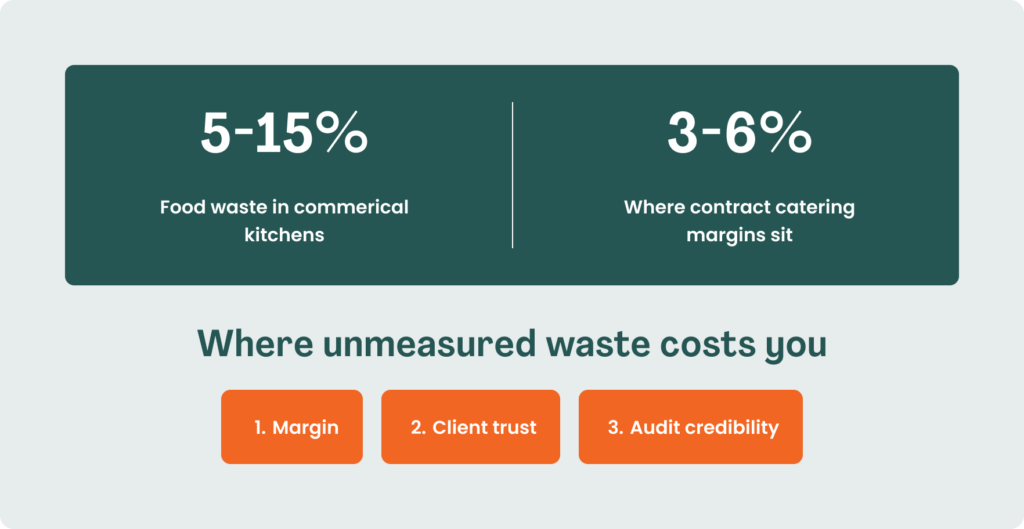
Commercial kitchens waste 5–15% of food purchased, and contract catering margins often sit at 3–6%. If both hold, waste is the difference between a profitable contract and break-even.
Unmeasured waste costs you on three fronts:
- Margin. Overproduction and fresh food spoilage stay hidden until the P&L lands.
- Client trust. Facilities managers notice overflowing bins, and long-standing relationships are built on a strong reputation for consistency. Visible waste puts renewals at risk.
- Audit credibility. Estimates are hard to defend when a client's sustainability team asks how you are tracking against their commitments.
The mechanism: no daily, ingredient-level evidence
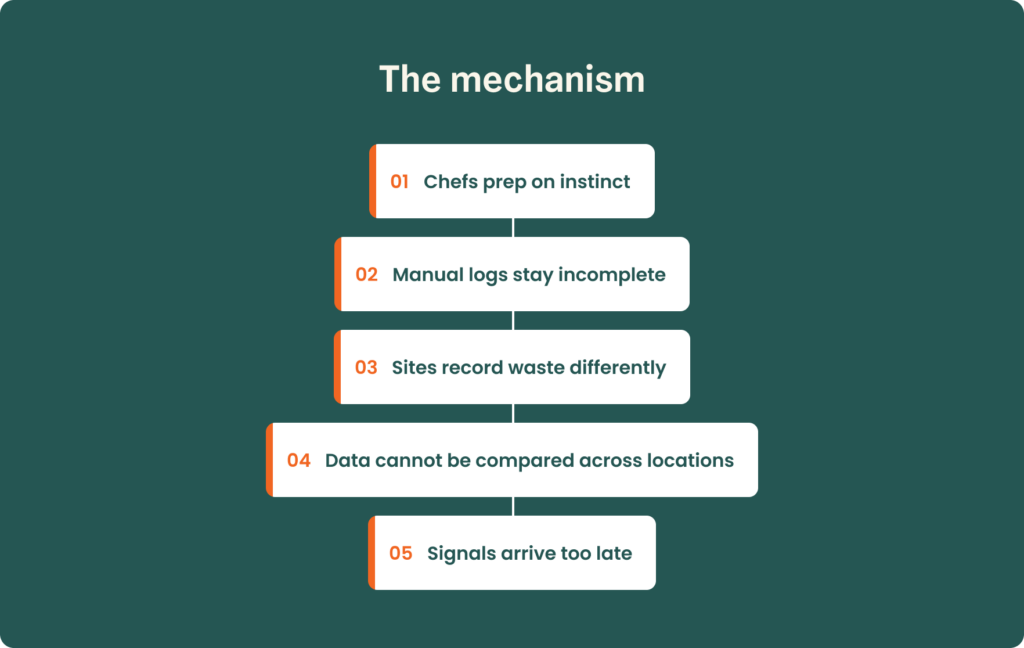
Without daily, ingredient-level evidence, chef instinct drives every prep decision. That instinct reflects the expertise of skilled chefs, but it cannot scale across a portfolio. The failure chain is predictable:
- Chefs prep on instinct. There is no measured baseline.
- Manual logs stay incomplete. Under service pressure, nobody pauses to record.
- Sites record waste differently. One logs by category, another by weight, a third not at all.
- Data cannot be compared across locations. The numbers do not mean the same thing.
- Signals arrive too late. By then, purchasing decisions are made and the money is spent.
Take a corporate catering contract at a London headquarters, where hybrid working makes headcount swing daily, so the hot counter is cooked for employees who never come in. Or a university servery where hospitality platters are made for an event that shrinks the day before. Dietary requirements add another layer: vegan, allergen-free and halal options are often prepped in small separate batches, and those runs are easy to overproduce. Each loss is avoidable, and none of it shows up in a log.
Most multi-site teams lack ground truth: one consistent, measured record of what was discarded at every site. Logged is not the same as measured, and that gap is where cost hides.
What large contract catering companies are doing about food waste
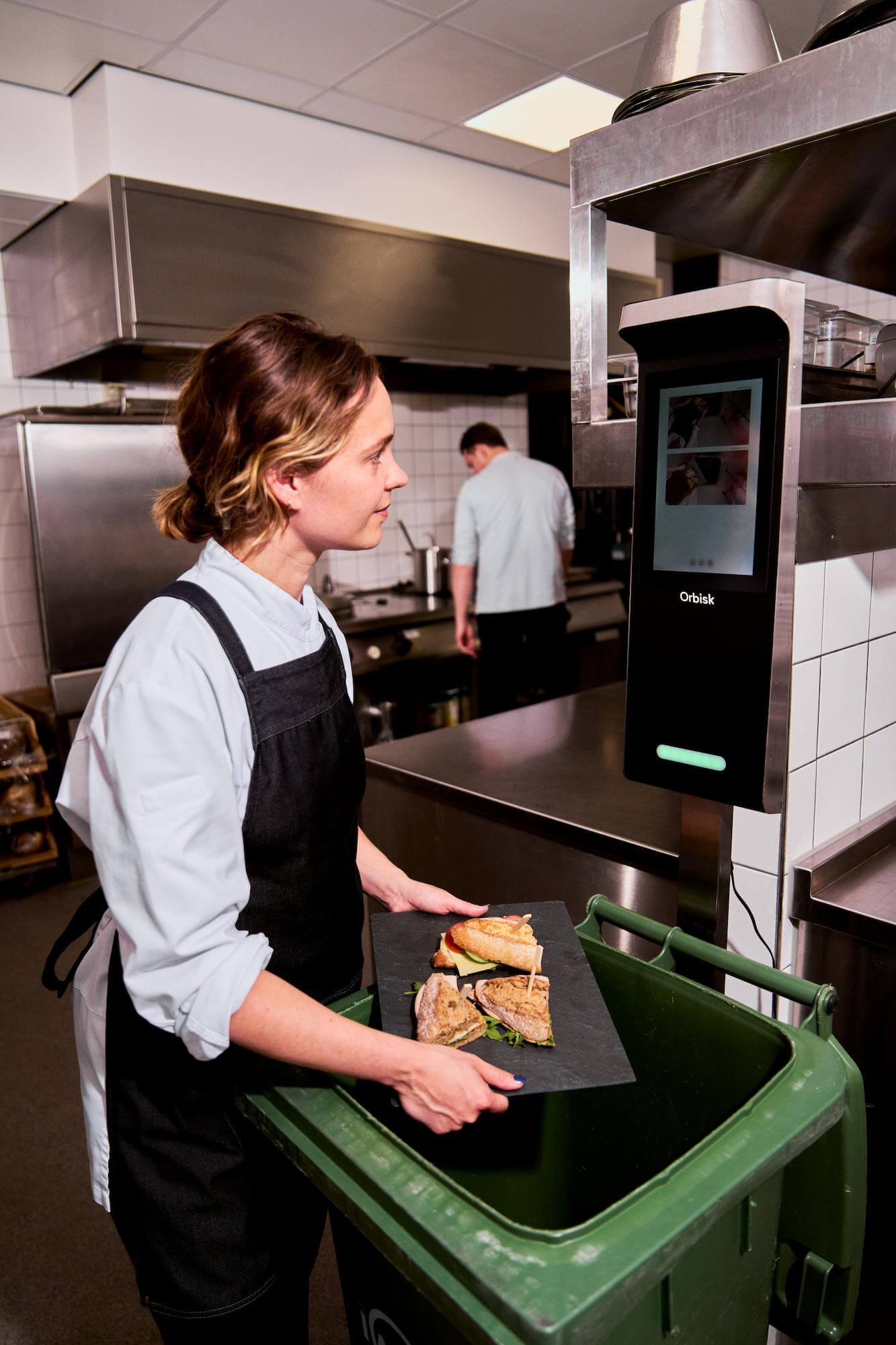
Measure at the moment of disposal, not from memory. Waste logged after service is guesswork dressed up as data. Leading operators capture it as it happens, ingredient by ingredient, before anything mixes. With Orbisk, staff just throw, and Orbisk captures everything in the background.
Standardise across sites. One capture method, one data structure, every kitchen. Otherwise each site produces its own version of the truth, however diverse your workplace environments are. This is why Orbisk captures identically at every site: the method is the standard.
Benchmark locations like for like. With Orbisk recognising 800+ ingredients at ~90% accuracy, you can find your best site and replicate it across the portfolio. The decision you can make this week: identify your lowest-waste kitchen by ingredient and category, and ask what is driving that number.
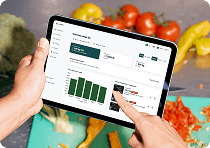
Feed waste data into procurement, production and menu development. For example, if 40% of your salmon spend went in the bin at three sites, that is a procurement conversation too. It is also a menu development conversation: measured data does not replace chef creativity, it shows which dishes and portion sizes are costing you. The Orbisk HQ Dashboard puts those patterns side by side across locations.
On ESG, reports built on estimates are harder to defend under scrutiny. Measured CO₂e of food waste, calculated from actual ingredient weights, gives you auditable figures and CSRD-ready output.
Measured vs estimated waste data: what changes for contract caterers
Estimated data tells you waste exists. Measured data tells you what, where and when.
| Estimated / Manual | Measured / Standardised | |
| Capture method | Staff logging, visual guesswork | Automatic capture at the moment of disposal |
| Ingredient detail | Broad categories or bin weights | Ingredient-level data (e.g. 1 kg salmon, 400 g lettuce) |
| Consistency across sites | Varies by team, shift and habit | Identical method at every location |
| Speed of signal | Weekly or monthly, if at all | Broken down by shift, with weekly reports |
| Credibility with finance and clients | Estimates that shift under scrutiny | Verified numbers that hold up in a meeting |
| ESG audit readiness | Manual compilation, gaps likely | Automated, auditable reporting |
For an operations lead, consistent measurement means comparing like with like. You can benchmark sites, spot outliers and set standards based on what happens in the kitchen.
The numbers: savings, payback and ROI
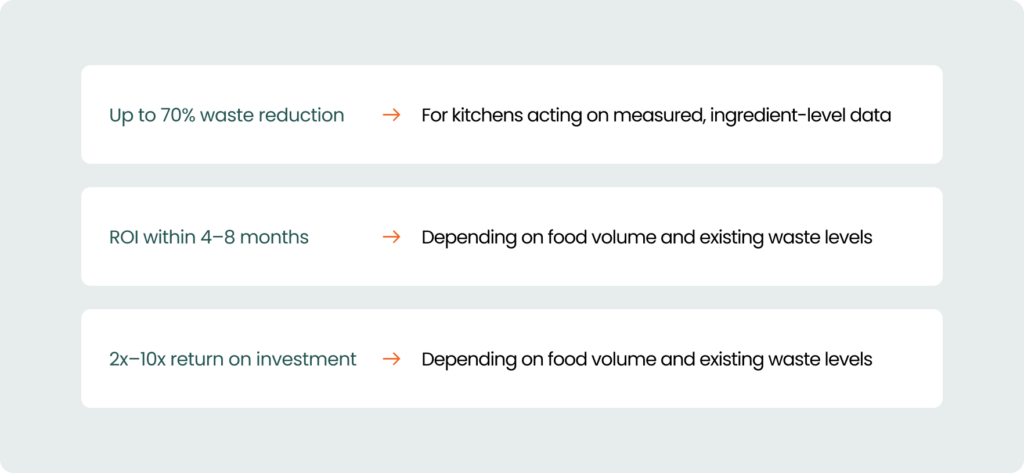
- Average of 40–50% waste reduction for kitchens acting on measured, ingredient-level data.
- ROI within 4–8 months, depending on food volume and existing waste levels.
- 2x–10x return on investment, depending on food volume and existing waste levels.
An ROI timeline of four to eight months can fall within a single budget cycle. For your finance team, that makes waste measurement a cost-reduction business case with a calculable return. It also traces food cost variance to specific ingredients and sites.
Buyers can see which ingredients are over-ordered and where supplier volumes outrun usage, which matters most for fresh food with a short shelf life. Waste data becomes a purchasing argument, and cutting overproduction does not have to mean compromising quality or running out mid-service.
These are customer-measured outcomes, not guaranteed results.
How to start reducing food waste across multiple sites
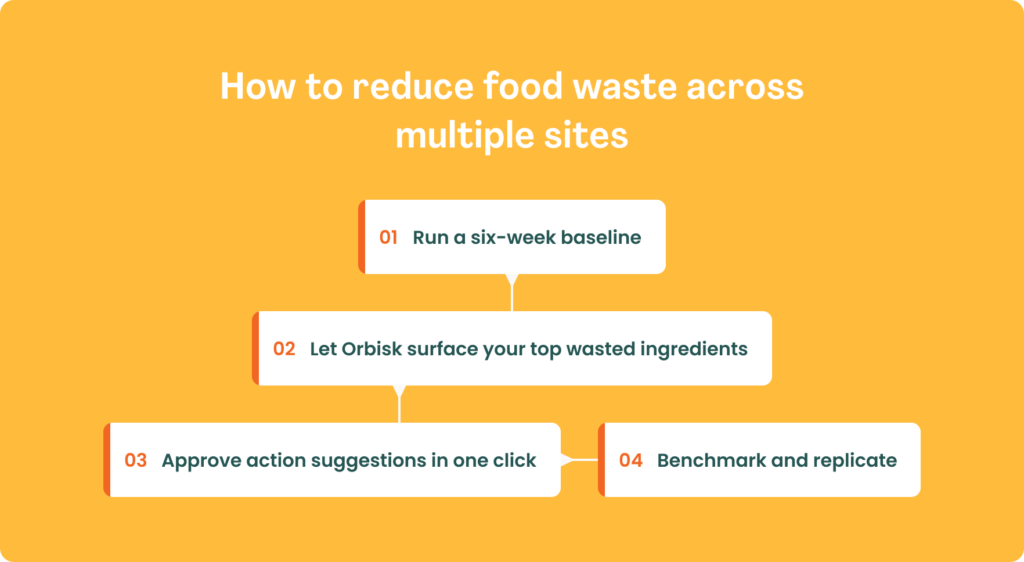
Start focused, measure everything, then scale what works.
- Run a six-week baseline. Pick 2–3 pilot kitchens with different service styles, such as a workplace dining site, a hospital and a university servery. Change nothing yet.
- Let Orbisk surface your top wasted ingredients. The platform ranks them automatically, with no manual diagnosis.
- Approve action suggestions in one click. Each week, Orbisk generates ingredient-specific action suggestions in the dashboard. Site teams review and apply them with a single click, and results are tracked against the baseline.
- Benchmark and replicate. Compare pilot sites like for like, then roll out what worked across the portfolio. Sharing site results with chefs builds a culture where waste is visible and owned.
The baseline also gives you CSRD-ready evidence: kg CO₂e of food waste prevented and percentage reduction against your starting point.
How Orbisk gives contract caterers one ground truth across every site
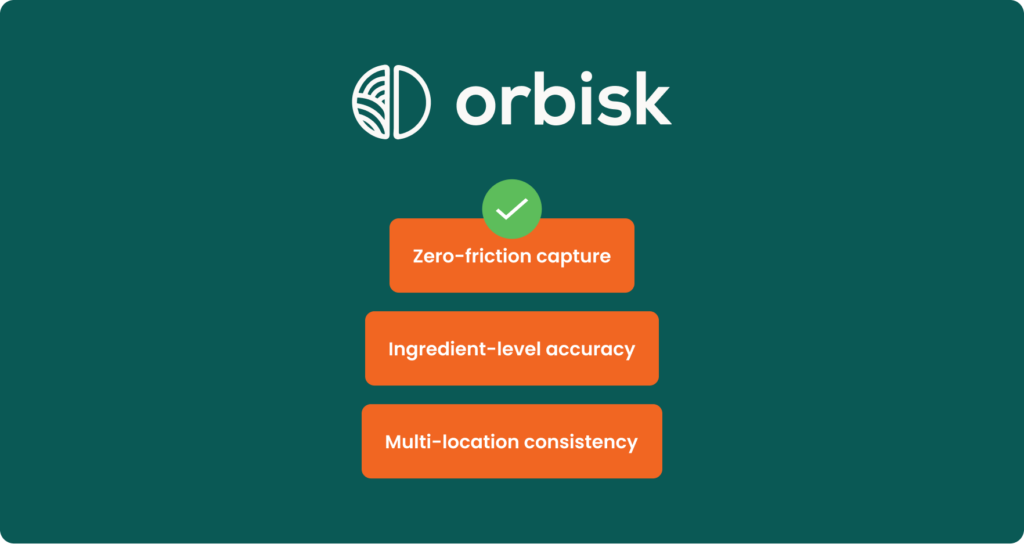
Orbisk is a food waste intelligence platform for professional kitchens. For contract caterers, it is one consistent set of eyes in every kitchen, capturing the same data the same way.
Zero-friction capture. A computer vision system records every discard at the moment of disposal, before ingredients mix. Staff dispose of food as they always have, with no buttons, logging or training. Setup takes under an hour per site, with no IT involvement, so a new contract can be measuring from day one.
Ingredient-level accuracy. The system recognises 800+ ingredients at ~90% accuracy, even during peak service. It also separates waste by stream, station and shift, detailed enough to show whether a loss comes from overproduction, prep or plate waste, and where in the operation it happens. When a chef or CFO questions the numbers, measured data holds up.
Multi-location consistency. Every site captures the same way, so one HQ Dashboard replaces a patchwork of site spreadsheets.
How it compares. Where capture happens decides what a food waste technology can record. Some systems capture at a tracker that waste has to be carried to; others register items inside the bin as they land. In both cases, complete capture is hardest to guarantee when service is busiest. Orbisk captures at the moment of disposal, so data completeness does not depend on how busy the kitchen gets. Inventory and ordering software works from purchasing data rather than direct capture, so it measures something different.
Orbisk is trusted by Vermaat, Accor, Marriott, Carnival, Fairmont and Raffles across 1,000+ professional kitchens in Europe, the USA and APAC, so the rollout process is established at enterprise scale.
Ready to run your kitchen on facts?
To see this across your sites, book a demo and we will show you real data from kitchens like yours.